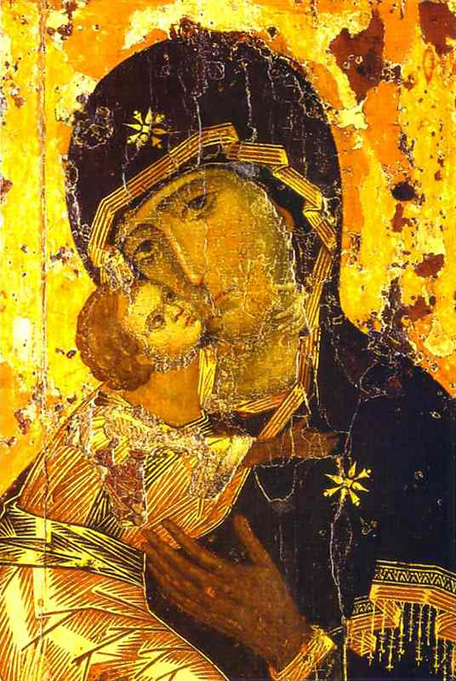
'And she spake out with a loud voice, and said, Blessed art thou amongst women, and blessed is the fruit of thy womb.' - Luke 1_42
|
It is truly meet to bless you, O Theotokos, ever-blessed and most pure, and the Mother of our God. |
Preliminery Notes / Definitions
'all generations shall call me blessed' - Lk. 1:48
'I will make thy name to be remembered in all generations: therefore shall the people praise (venerate) thee for ever and ever' - Ps. 45:14
The Orthodox veneration of the Theotokos is to be understood in the larger context of the Orthodox veneration of Saints. However in degree it far surpasses all other veneration - for the mystery of the incarnation far surpasses all other God / Man interactions. The Incarnation is the truly the greatest of all mysteries; surpassing even the creation of the world. For the transendant God to create the world is a concievable notion, but for God who trancends all things whose glory even the heavenly realms cannot contain, to enter into that creation and take upon Himself human flesh is a mystery beyond all contemplation. Though the incarnation took place only many generations later in human history once the 'fullness of time had arrived' (Galatians 4:4), the Holy Scriptures call the incarnation the 'mystery hidden before all ages' (Ephesians 3:9, Colossians 1:26, 1 Corinthians 2:7, Romans 16:25) - meaning it was the very plan of God even before creation, before the ages were established, before the fall, before Adam and Eve - it is the very reason the heavens were established, and the material world brought to being and man made in the image of God. Thus in Orthodox theology, the Incarnation is the very reason ('logos' in Greek) for creation. Without the incarnation, our union with God (theosis) - something which Adam did not yet possses - would have remained an impossibility even if the Fall had not taken place.
For the heterodox (papists, protestants) who want to objectively analyze the Orthodox understanding of the Theotokos, it is necessary to abandon all preconcieved notions they may have inherited through their own erroneous traditions - and to begin anew with the simple yet profound truth that is modestly veiled in scripture and quietly hidden within the heart of the Orthodox Church; a most difficult task given the many misconceptions in the post schism west has accumalated over the ages regarding the Mother of the Lord. Foremost in this endeavor, I would strongly caution that Eastern Orthodox Theotokology is vastly different from papist psuedo "mariology". It needs to be looked at afresh, without the taint and biases of heterodox notions that are familiar to papism and protestantism but altogether foreign to the Orthodoxy.
To understand Orthodox Theotokology is to understand the Orthodox Church. God desires for all men to come to Salvation through the Right Faith (see John 4:22) and even to those whose hearts are initially clouded by doubts about the Orthodox Tradition concerning Theotokos, He has left us ample proof - even in the scriptures - if we are willing to seek with our hearts not denying the truth that is set before our very eyes - lest our 'knowledge' of scripture become a stumbling block as it was to the disbelieving Pharisees and scribes - for this is indeed 'hard saying; who can listen to it?' (John 6:60). As in all our endeavors we must begin with love and humility; abandoning both our pride and our intellectual convictions and look afresh at what is presented before us in the divinly inspired Holy Scriptures.
'And it came to pass, as he spake these things, a certain woman of the company lifted up her voice, and said unto him, Blessed is the womb that bare thee, and the paps which thou hast sucked.' - Luke 11:29
'He said, [indeed / most certainly] blessed are they that hear the word of God, and keep it' - Luke 11:28 (often mistranslated and cited in apologetics against the mother of the Lord). See greek lexicon here.
'And blessed is she that believed: for there shall be a performance of those things which were told her from the Lord'. - Luke 1:45
'Hail, thou who art [favoured with grace (κεχαριτωμένη)], the Lord is with thee: blessed art thou among women' - Luke 1:28
'And she [cried out with a loud voice (ἀνεφώνησεν)] and said, Blessed art thou among women, and blessed is the fruit of thy womb.' - Luke 1:42
The word 'ἀνεφώνησεν' seldom appears in the Holy Scriptures, occuring just once in the New Testament in Luke 1:42. The five occurances of the word occurs in the Old Testament Scriptures (Septuagint) are all associated with the Old Testament Temple Worship: 1Chr 16:42, 2Chr 5:13; 1Chr 16:4; 1Chr 15:28; 1Chr 16:5
'all generations shall call me blessed' - Luke. 1:48
Related Download: The 'Brothers' of the Lord
There are numerous typologies in the Old Testament of the Theotokos; the most repeated one being the typology between the Theotokos and the Ark of the Old Covenant.
| The Ark of the Old Covenant which contained the 'words of God' engraved in stone |
The Theotokos - Ark of the New Testament whose womb contained the 'Word of God' in the flesh |
|
| 1 | The ark traveled to the house of Obed-Edom in Judea (2 Sam. 6:1-11). | Mary traveled to the house of Elizabeth and Zechariah in Judea (Luke 1:39). |
| 2 | Dressed in linen ephod worn by priests, David danced and leapt in joy before the ark (2 Sam. 6:14). | John the Baptist — of priestly lineage — leapt in joy in his mother's womb at the approach of Mary (Luke 1:41). |
| 3 | David asks, “How can the ark of the Lord come to me?” (2 Sam. 6:9). | Elizabeth asks, “Why is this granted me, that the mother of my Lord should come to me?” (Luke 1:43) |
| 4 | David shouts in the presence of the ark (2 Sam. 6:15). |
Elizabeth “exclaimed with a loud cry” in the presence of Mary (Luke 1:42). |
| 5 | The ark remained in the house of Obed-Edom for three months (2 Sam. 6:11). |
Mary remained in the house of Elizabeth for three months (Luke 1:56). |
| 6 | The ark returns home and later on goes to Jerusalem to be placed in the temple (2 Sam. 6:12; 1 Kgs. 8:9-11). | Mary returns home and later on goes to Jerusalem, where she presents the incarnate Word of God in the temple (Luke 1:56; 2:21-22). |
| 7 | The ark contains the stone tablets of the law; the word of God engraved in stone | Mary carries in her womb the Divine Logos; the Word of God made flesh |
| 8 | The ark contains the jar filled with manna from the wilderness which was a miraculous bread from heaven | Mary carries in her womb Christ, the bread of life from heaven (John 6:41) |
| 9 | The ark contains the rod of Aaron that budded to establish his status as true high priest | Mary carriess in her womb the Lord; the true and eternal Great High Priest of the God Most High |
| 10 | The vision of the Ark appears is given to St. John, the beloved disciple Rev. 11:19 | Immediately following the vision of the ark is the vision of the woman (Mary) who gives birth to a male child who will rule the nations with a rod of iron. Rev 12:1 |